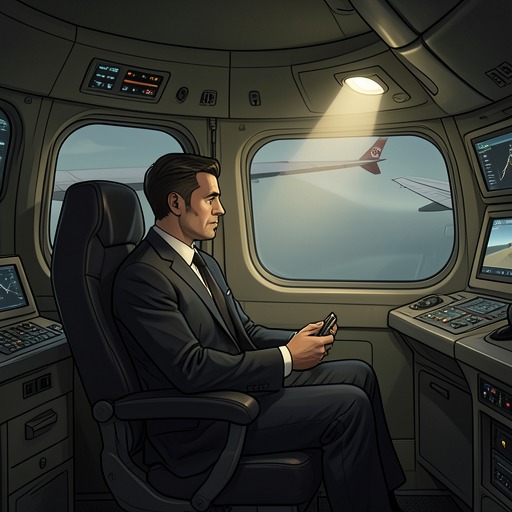
Passenger aircraft landing gear camera
All the Old KnivesThe alleged undercarriage camera on Royal Jordanian Flight 127 becomes a small but decisive object in the hostage crisis: its reported presence appears to expose the aircraft’s vulnerable underside and overturn a proposed rescue plan. Yet the device is never verified, and the message that reports it is later recognized as not having come from Ahmed Najjar. The camera therefore matters both as a possible tactical advantage for the hijackers and as a point where uncertainty about the evidence itself becomes part of the danger.
Intelligence and the Proposed Assault
The camera enters a crisis already shaped by imperfect intelligence. A source called TRIPWIRE warned of an airline-related event within seventy-two hours on a flight bound for Austria or Germany, naming Aslim Taslam as the group involved. The warning was treated cautiously: TRIPWIRE had previously sent the station toward an empty warehouse in Salzburg. But a Europol report that Mashood Al-Fakeeh, believed to be Ilyas Shishani, had arrived in Barcelona from Jordan gave the warning new weight. Analysts suspected Shishani might be among the operational planners associated with the impending attack.
The predicted crisis came aboard Royal Jordanian Flight 127, which left Amman and landed in Vienna. The Airbus carried 120 passengers and crew. After landing, the hijackers rose from their seats; Suleiman Wahed shot a stewardess who had asked him to sit down. The hijackers later demanded the release of five prisoners within forty-eight hours, while the governments weighed the risk of giving in against the possibility of an assault before the deadline.
Five hours after the hijacking began, Ahmed Najjar sent an emergency message to Langley. Traveling on a Lebanese passport, he was a courier and a source aboard the plane. His brief report described four attackers with two guns, the passengers’ arrangement in the cabin, children in first class, two women in critical condition, dwindling water, and a lack of power that meant there were no cameras inside. He proposed an attack through the rear undercarriage. That suggestion made the aircraft’s underside seem like a potential route to the hostages, but only while it remained unobserved.
The Camera Report and Its Tactical Effect
A later message attributed to Ahmed reversed that assessment. It said to abandon the attack plan because the hijackers had a camera on the undercarriage, adding that they appeared to know what they were doing and urging the authorities to meet their demands or risk everyone dying. If accurate, the report meant that a team approaching beneath the plane could be detected. The camera thus changed the meaning of the proposed entry point: what had seemed a way in could instead be a watched approach.
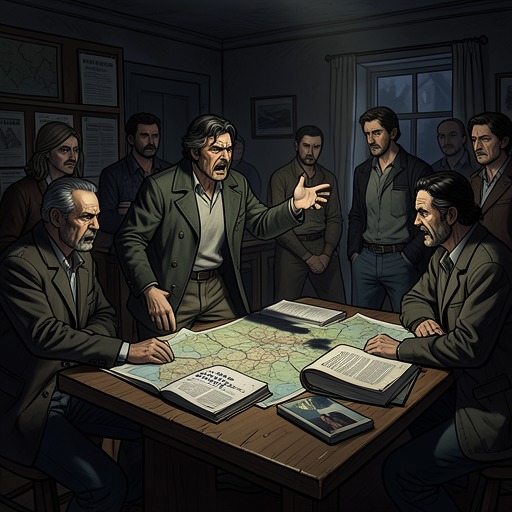
The station could not explain how such a device had been installed. Ernst Pul suggested that a baggage loader at Amman airport might have attached a remotely operated camera to the aircraft’s hull. This was a hypothesis, not a confirmed account of the device’s installation. Bill Compton raised the more immediate problem that Austrian authorities and television crews had been filming the plane throughout the day without anyone noticing anything unusual. Leslie MacGovern connected a laptop to the office screen so the group could review the available material: much came from ORF, while about five minutes consisted of high-resolution footage shared by the Austrians with the concerned embassies. The camera remained unseen. Owen Lassiter cautioned that failing to spot it in the footage did not prove it was absent.
The report nevertheless had operational consequences. The proposed rear-undercarriage assault was scratched, and the message’s author urged compliance with the hijackers’ demands. Meanwhile, the group’s ability to investigate depended on whether it would share what it knew. The Austrians had not been told that Ahmed was on board, and the station’s staff feared they could not trust the Interior Ministry with that information. Celia Favreau argued that the evidence should be shared because saving lives required cooperation. The hidden source and the unverified camera claim therefore became intertwined: the team was being asked to change its course on the basis of intelligence it was reluctant to disclose to the people best positioned to check it.
A Message Under Suspicion
When the messages were considered together, the supposed camera report itself became suspect. Ahmed’s earlier texts were compressed and incomplete. The later report used complete sentences, the more leisurely phrase “it is,” and articles such as “a camera” and “the undercarriage.” Celia noticed these differences and concluded that the fourth message had been written by someone else. The text did not establish that no camera was present; it established that the claim could not safely be treated as Ahmed’s verified observation. The distinction is critical: a warning may be tactically consequential even when its source is uncertain, but uncertainty about authorship undermines the confidence with which the warning can guide action.
The device’s existence is never independently settled in the available account. The office reviews footage but finds no clear confirmation; the proposed method of installation remains conjecture; and the later discovery about the message’s author further complicates the report. The camera consequently functions less as a recovered piece of equipment than as an unresolved intelligence problem—something that may have been real, but whose presence the team could neither demonstrate nor dismiss before making decisions about the hostages.
Consequences and Significance
The camera report sits within a larger failure of information handling. Ahmed’s messages offered the station an unusually close view of the aircraft, but his identity was withheld from the Austrians, limiting the sharing and checking of intelligence. Later, Henry Pelham confronts Celia over a call to Ilyas Shishani that, he alleges, disclosed information about Ahmed and destroyed the team’s only chance to save the people aboard. That accusation does not prove who authored the camera report or whether the device existed; it does show how the crisis’s communications became bound up with secrecy, suspected betrayal, and decisions made without public or judicial review.
As an object in the narrative, the undercarriage camera marks the point where a technical detail threatens to redirect an entire rescue effort. Its reported placement beneath the aircraft promises surveillance of the precise approach the team had considered, while its absence from reviewed footage leaves that threat unconfirmed. The result is not a clean tactical revelation but a more perilous condition: the team must act under pressure while unsure whether the plane is watched, whether the report is authentic, and whether the intelligence can be shared with those who might verify it.